


Table of contents
- What is an AI taxonomy in education?
- Progress vs prohibitive: ban AI, allow free use, or something else entirely?
- What is the AI Assessment Scale (AIAS)?
- How do global regulatory standards define learning assurance?
- What technology is required to implement an AI taxonomy in education?
- How can an AI taxonomy support long-term learning assurance?
Rather than a simple binary, educator perspectives on generative AI exist on a wide spectrum. On one end are valid calls for complete prohibition over ethics, privacy, and sustainability. On the other is the struggle to calibrate meaningful guardrails for classroom integration. Navigating this continuum requires moving beyond blanket rules toward clear, assignment-level guidance.
What you need to know
- An AI taxonomy in education is a framework that defines levels of AI participation in assessment.
- Turnitin Clarity’s configurable AI assistant offers control of student AI usage, supporting the move from AI bans to integration.
- Download our new eBook for practical implementation tips that support genuine learning and human-led creativity. ⬇️
Even if institutions have set rules around acceptable AI use, instructors may still struggle to determine what students have truly mastered and what represents the work of AI.
When visibility into the thinking process gets muddled, it creates a break in learning assurance - the guarantee that students achieve core learning outcomes through reliable assessment. Without that visibility, a dangerous gap opens between policy intent and classroom reality, leaving educators hoping learning happens without any way to verify it.
What is an AI taxonomy in education?
An AI taxonomy in education is a system that prioritises transparency and visibility in students’ processes, while promoting human-led critical thinking. It helps educators make the transition from hoping students are learning, to knowing students are learning—which builds trust between students and instructors.
An AI taxonomy is important for institutions to transition from simply banning or permitting AI, to guiding its use for the best learning and instructional outcomes. It safeguards authentic student learning while promoting transparency - all while keeping the student in the loop every step of the way.
Generic, unregulated AI tools can support course expectations on paper, but they can’t uphold or validate policies in practice. Institutions must have an evidence-based strategy that proves course learning outcomes are being met, even when AI tools are fully integrated into the workflow.
Progress vs prohibitive: ban AI, allow free use, or something else entirely?
AI use clearly isn’t slowing down.
But instead of banning AI use outright or allowing unregulated access with unapproved platforms, it’s important to establish explicit guidelines with an AI taxonomy educators can easily follow:
- Define the expectations: Be explicit about whether AI is allowed for different elements of the task. Maybe educators want students to brainstorm their own ideas but allow students to use AI for editing or revision. No matter what, define it concretely so it is clear what is and is not permitted.
- Calibrate the logic: Explain to students that they shouldn't let AI do all the thinking or provide direct answers.
- Validate the learning: Ask students to reflect on how they used AI with a disclosure statement or submit chat logs for review. Teach students to cite AI, just as they would any other source.
Recent data shows that while almost all students use AI, only 36% feel encouraged by their institution, and only 38% say they are provided with AI tools.*
Despite the lack of standardised tools, the Higher Education Policy Institute (HEPI) reports 95% of undergraduates use AI in some form in 2026, mostly unregulated, and almost half (49%) of students believe AI has improved their student experience by saving time, improving understanding, and providing instant support.
Robin Gibson, director of external affairs at Kortext, says AI use is evolving rapidly. And it’s crucial to evolve with it:
“Universities are starting to close the gap between student expectations and AI provision and teaching, with more institutions now offering supported access to trusted tools,” she said. “This year’s findings show increasing momentum, with a sector preparing to match students’ enthusiasm and expectations in delivering institutional capability, but there is more to do.”*
What is the AI Assessment Scale (AIAS)?
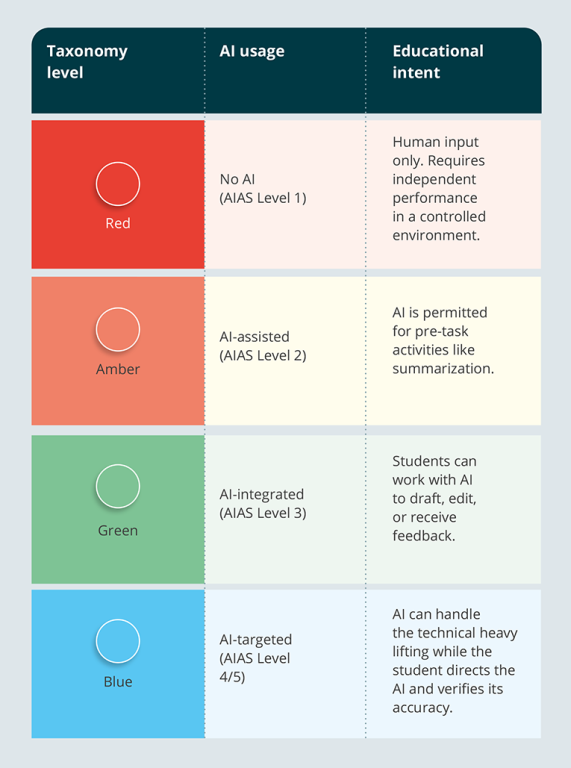
The AI Assessment Scale (AIAS) was developed by Mike Perkins, Leon Furze, Jasper Roe, and Jason MacVaugh in 2023. The in-depth scale provides a framework for educators to give clear expectations around AI, and integrate AI into educational assessments.
The AIAS is used by hundreds of schools and universities worldwide and translated into more than 30 languages. As a set of frameworks and tools for generative AI adoption and integration, it offers multi-dimensional metrics to map the quality of AI involvement.
How do global regulatory standards define learning assurance?
Global quality frameworks rely on AI taxonomies like the AIAS to guide educators and students down a clear path of responsible AI use. Process visibility is becoming essential for learning assurance in AI-permitted assessments globally.
How TEQSA sets the standard for AI learning assurance in Australia
In Australia, the global quality standard is formalised as a strict regulatory requirement by the Tertiary Education Quality and Standards Agency (TEQSA). Under TEQSA’s Higher Education Standards framework, institutional compliance hinges on delivering a reliable, transparent audit trail of learning assurance through traffic-light systems that substantiate learning outcomes in both AI-restricted and AI-permitted situations.
The University of Sydney’s two-lane model is deliberately binary, to ensure that graduates can demonstrate the knowledge through “secure” assessments (lane 1) and be able to learn through “open” assessments that support the use of AI (lane 2).
However, UNSW Sydney’s multi-lane approach uses a more granular, course-specific framework, ranging from no AI allowed to AI-assisted editing, through to full AI integration. UNSW decentralizes AI decisions to the faculty and course-convenor level.
Real-world AI taxonomy examples in US and UK institutions
In the US and the UK respectively, the University of Iowa and University of Stirling now adopt AIAS for assignment design. The system helps instructors make intentional design choices, emphasize learning processes, and communicate expectations to students.
The University of the Arts London uses a simple three-tier traffic-light categorisation closely aligned with AIAS. And although the University of Leeds also manages AI use in this way, they specify that the three categories of red, amber and green are not rigidly defined, but “intended to create a shared understanding between staff and students of how to use Generative AI tools in a particular assessment, by how much and at what stage of the assessment process.”
What technology is required to implement an AI taxonomy in education?
Without an infrastructure capable of enforcing and scaling a pedagogical framework, setting guardrails for AI use may feel futile.
Turnitin Clarity is a transparent writing tool with built-in AI assistance designed for education. With configurable AI settings, instructors choose the extent to which AI assistance is active for each task and set the AI assistant’s ‘reading level’ to match the student’s academic stage and learning objective, in order to ensure that the guidance provided is accessible to the student.
With added automated transparency tools, including an instructor preview tool, activity overview dashboard, and time-lapse writing playback, Turnitin Clarity’s infrastructure equips instructors with the insights that foundational teaching relies on to support authentic learning, build responsible AI skills, and give students the confidence to write in the age of AI.
Purpose-built environments like Turnitin Clarity provide configurable AI tools to develop students’ AI literacy and visibility into the writing process that institutions need to authenticate student learning.
How can an AI taxonomy support long-term learning assurance?
A framework that defines exactly where AI adds value and where it hinders learning is the first step to helping students navigate AI use in assignments.
Ready to implement an AI taxonomy framework within your institution?
Download our new eBook to access four ready-to-use assignment scenarios—complete with exact Turnitin Clarity feature configurations for pre-writing, drafting, revision, and technical problem solving.
About the author
Patti West-Smith leads our Customer Engagement team as the Senior Director of Customer Engagement. Before coming to Turnitin, Patti spent 19 years working in every capacity in school districts in the United States as teacher, principal, curriculum supervisor, and many more roles, while also working on local, state, and national curriculum and assessment development projects. Patti also served as an adjunct professor at Salisbury University in their teacher preparation program and acted as an independent professional learning consultant. With degrees in education, literacy, and leadership, she also holds certification as a superintendent.
Since coming to Turnitin ten years ago, Patti has continued to work to create content and professional learning opportunities to support educators around the world in the understanding of pedagogy and implementation of Turnitin’s products and services, including around the evolving impact of AI generative tools. She also passionately serves as one of Turnitin’s resident advocates for the needs of educators and students alike and has co-authored research around the impact of feedback with Dr. John Hattie.
Follow Patti on LinkedIn