


AI is reshaping how students learn, create, and demonstrate knowledge. A shift challenging educators to ensure assessments accurately measure what students truly know, understand, and can do.
This is especially critical in professional fields such as medicine and law, where competence has real-world consequences. Institutions are now turning to assessment data to inform instruction, improve quality, and accelerate student remediation.
Dr. Pooja Adtani of Gulf Medical University (GMU) uses ExamSoft by Turnitin’s offline environment and longitudinal reporting to validate student mastery in an AI-enabled education landscape, and uses assessment data to inform instruction.
What you need to know
- As AI takes heed, medical education requires assessment systems that reliably demonstrate authentic student competency and readiness for clinical practice.
- GMU utilizes ExamSoft’s secure, offline environment to prevent AI interference during high-stakes exams, validate outcomes, and use data for instructional improvement.
- A transition from "detecting cheating" to "assessing learning" drives continuous improvement in instruction and assessment, plus more targeted student remediation processes.
How does AI risk invalidating high-stakes medical assessment?
AI tools are now embedded throughout the student learning journey and can be used in ways that both legitimately support learning and illegitimately emulate it.
At one end of the spectrum, unintentional over-reliance on AI can limit the development of deep knowledge and critical thinking skills required for professional practice. At the other, deliberate misuse in high-stakes examinations can ‘fake’ competence that hasn’t been genuinely achieved.
In this AI-enabled environment, high-stakes medical assessments must be designed to reliably test authentic knowledge, subject mastery, and professional competence, while also safeguarding against emerging forms of misconduct, including the use of AI agents in online examinations.
How has Gulf Medical University addressed AI risks in exams?
In her webinar presentation – Building Smarter Assessments: A Data-Driven Framework for Transparent and Purposeful AI Design – Dr Adtani described how GMU addresses the AI challenge using Miller’s Pyramid, PICRAT, and ExamSoft’s offline assessments as the foundation.
The approach not only strengthens the validity of medical assessments as a measure of true student mastery, but also generates clean, high-quality data that can be used to enhance instruction, assessment design, and student remediation.
ExamSoft’s offline assessment environment has been central to this transformation. Removing online connectivity during high-stakes exams has eliminated the internet access AI agents use to compromise assessment integrity.
But it also ensures assessment data accurately reflects student performance, giving GMU confidence to use that data to drive evidence-based improvements in teaching, learning, and curriculum design.
This approach goes beyond securing assessments from AI threats. It is about evolving institutional policies away from policing AI and towards an AI-enabled pedagogy that leverages the benefits of AI in education while mitigating risk.
ExamSoft transforms assessments into measurable evidence of student learning. Educators and academics are looking for quantitative data so that they can improve their assessments continuously.
![[dr_pooja_adtani___gmu:MEDIASTORE_LEAF]@5292b6dc](../assets/images/photos/headshots/dr-pooja-adtani-gmu.png)
How does GMU design high-stakes medical education assessments?
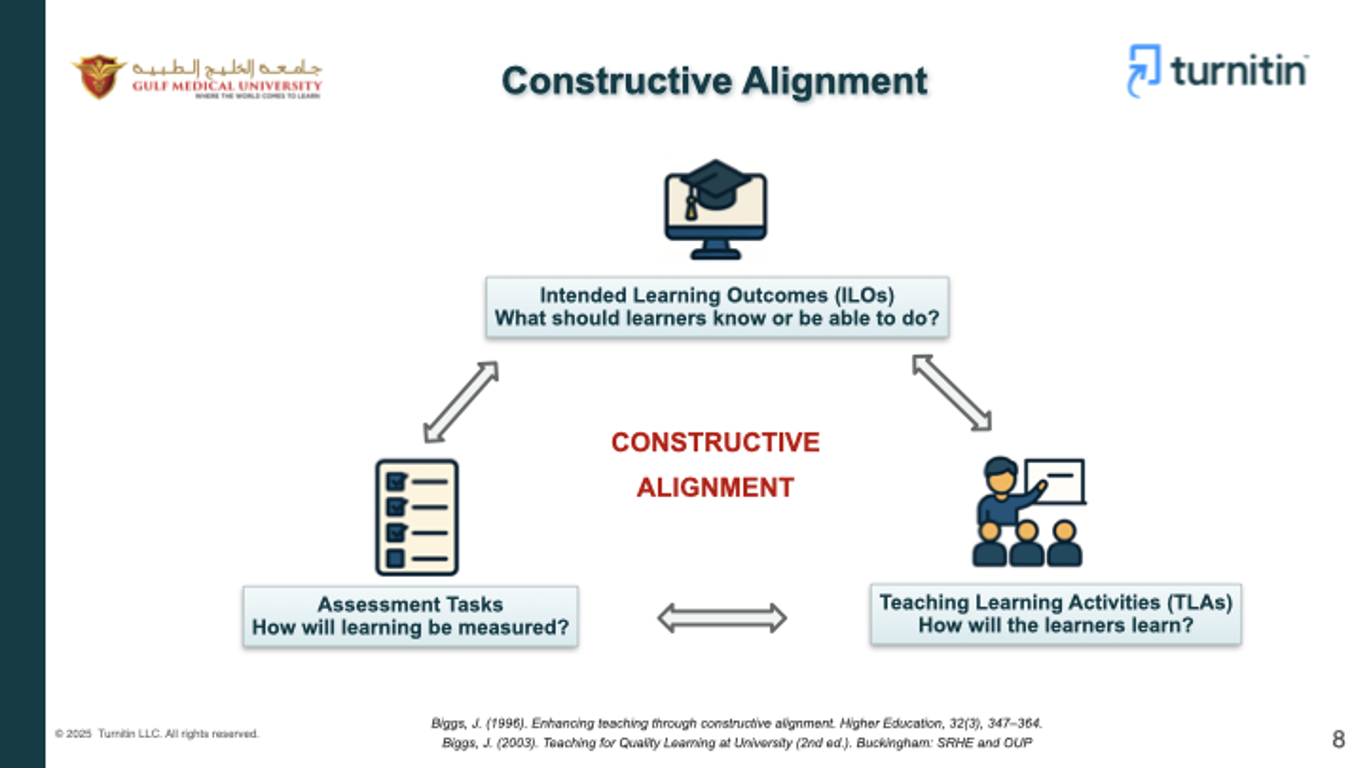
A key element of GMU’s assessment strategy is constructive alignment, which ensures that teaching and assessment are designed to deliver intended learning outcomes.
- Intended Learning Outcomes (ILOs): What should learners know or be able to do?
- Teaching Learning Activities (TLAs): How will the learners learn?
- Assessment tasks: How will learning be measured?
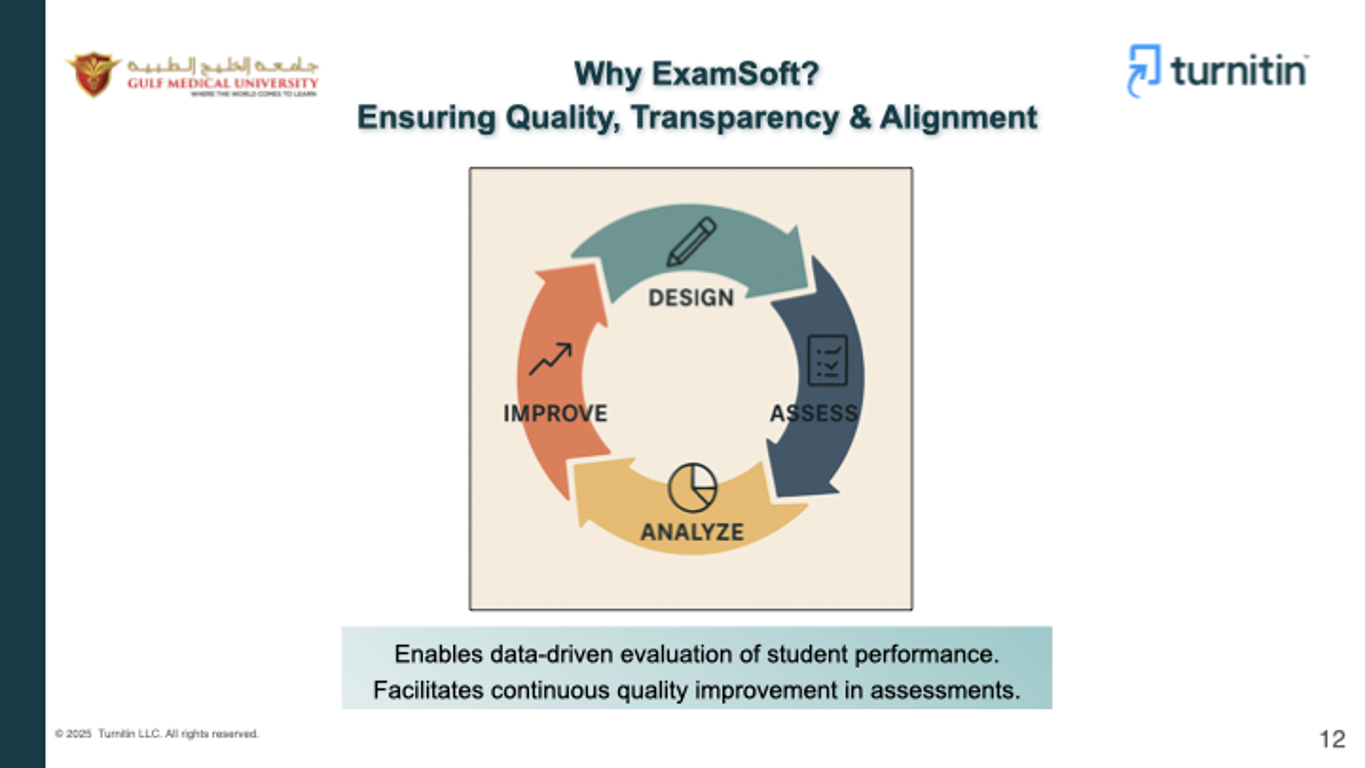
This is not a one-time effort. Educators continuously design, assess, analyze, and improve assessments – enabling data-driven evaluation of both student performance and assessment quality.
To ensure assessments don’t just test rote recall but genuine professional capability, GMU uses Miller’s Pyramid to structure assessments that progressively evaluate competence. This used to be manually mapped in blueprints that aligned each assessment item to specific Bloom’s taxonomy levels, as well as course and program learning outcomes.
Now, faculty create them quickly and efficiently in ExamSoft, which allows educators to create questions and tag them with a range of parameters, to ensure every question serves a defined pedagogical purpose.
How does GMU use post-item analysis as a diagnostic?
Post-item analysis sits at the core of GMU’s approach as a diagnostic infrastructure for curriculum and assessment improvement. Rather than treating grading as the endpoint, GMU uses assessment data as the beginning of a continuous feedback loop, using assessment data to inform instruction.
Dr Adtani emphasised that post-item metrics help faculty identify question quality issues rather than student performance issues, and highlighted key metrics that she finds particularly valuable.
- Category summary report: Shows the percentage of course or program learning outcomes achieved in each exam, to ensure curriculum alignment
- Difficulty index: Indicates how easy or difficult each question is for students, supporting assessment calibration
- Point-biserial (discrimination) index: Measures how effectively each question differentiates between high- and low-performing students
- Distractor analysis: Identifies whether multiple-choice distractors are functioning effectively or require revision due to non-selection
- Exam reliability (KR-20): Evaluates the internal consistency and stability of the assessment
Together, these transform assessment into a diagnostic tool for continuous pedagogical improvement, enabling faculty to refine both teaching strategies and assessment design.
ExamSoft’s category reports and longitudinal post item analysis are a data goldmine that help us continuously improve assessment.
How ExamSoft by Turnitin supports GMU’s objectives
Combining Miller’s Pyramid, PICRAT, and ExamSoft’s offline assessment environment, GMU redesigned its assessment strategy to better validate authentic learning and professional readiness.
In the AI-enabled landscape, this integrated approach strengthens exam design and supports more confident validation of learning outcomes, while reinforcing academic integrity and meeting accreditation requirements.
Crucially, by preventing AI-enabled misconduct in high-stakes exams, when GMU uses assessment data to inform instruction, they know it is clean, reliable, and actionable.
By focusing on detecting learning rather than cheating, GMU creates a more transparent and supportive environment for learners and educators alike. This shift from policing to pedagogy positions educators as guides rather than gatekeepers, and protects vital trust-based student-teacher relationships.
Learn how Turnitin can help you use assessment data to inform instruction
About the author
Chukwudi Ogoh is an Academic Strategy Consultant at Turnitin, working across Asia Pacific and Europe, Middle East and Africa to help institutions enhance student learning outcomes through effective assessment, feedback, and academic integrity practices. He collaborates with senior leaders, academics, and teaching teams to align institutional priorities with solutions such as Turnitin Feedback Studio, Gradescope, Turnitin Originality, and Turnitin Clarity. With more than a decade of experience in higher education and edtech, he brings expertise in pedagogy, digital transformation, and assessment innovation.
Follow Chukwudi on LinkedIn